
Teams
・
.
.
The backend works like a food delivery app
A conversation with Rob, Back-End engineer — MODI Factory
Behind MODI Factory's ability to place and route complex PCB components in seconds sits a backend system that carries enormous volumes of data safely all the way to the user's screen.
We sat down with Rob, the engineer holding up MODI Factory's invisible engine, to talk through all of it: the architectural work that makes large PCB data manageable, the move to AWS cloud infrastructure that cuts how long users wait, and what engineering really comes down to in the age of AI.
Read Rob's interview if you are:
✅ A developer wrestling with backend and infrastructure design for data-intensive products
✅ An engineer who wants a clean data pipeline between AI models and the frontend
✅ A student or junior developer thinking about what backend engineering comes down to, and where it is headed, in the age of AI
Part 1. A wider view of the whole system
Could you introduce yourself and tell us what you handle at MODI Factory?
Hi, I'm Rob. I've been a backend engineer for about five years now. At MODI Factory, I handle development and operations across the backend and infrastructure.
You studied information systems engineering as an undergraduate and did your master's in blockchain. Both fields look at systems as a whole. How has that shaped the work you do now, moving between backend engineering and DevOps to build out infrastructure?
What you study at university is closer to first principles than to day-to-day practice. But because I had a solid grounding in courses like data structures, databases, and design patterns, I've been able to hold on to clear principles and consistency even inside fairly complex system architectures.
Part 2. Getting data to the screen
MODI Factory is an AI-based EDA tool. When you designed the backend and infrastructure, what was the technical challenge you paid the most attention to in terms of speed and stability?
I'd split that into the backend side and the infrastructure side.
On the backend, the closest comparison is a design tool that works with large assets. Image editors handle files running from a few megabytes to tens of megabytes, and PCB data puts a similar load on the system. Since PCB data is heavy by nature, I leaned on caching as aggressively as I could to bring response times down. I also split the most demanding jobs out into separate microservices to keep the system stable.
On the infrastructure side, the biggest challenge was scheduling and distributing resource-hungry AI server jobs reliably, which I handle through the Kubernetes Operator Pattern.
How does the backend take the complex component placement results the AI team produces and get them onto the user's screen in real time?
Three stages, broadly:
Take the user's request, schedule the task, and hand it off to the AI server.
Push progress updates to the user in real time as the AI server reports them.
Post-process the finished task into a final result and deliver it to the user.
In short, it's the pipeline that carries what the AI computes over to the screen the user is looking at, so it can be visualized there.
If you had to put it in an analogy, how would you describe your role as a backend engineer in getting AI output to the frontend?

Rob, working to prevent delivery mishaps at MODI Factory
Inside the dev team, we joke that my role is the delivery position. If the AI is the restaurant owner and the frontend is the customer, then I run the ordering platform and the delivery service.
What actually happens looks a lot like that, too. The customer (frontend) placed the order correctly, the owner (AI) cooked the food and sent it out, and somewhere in between I'm the one hearing "Why hasn't my order arrived?" or "This isn't what I ordered."
We hear your mission is making sure projects run without a hitch. What's the metric you watch most closely when you're judging MODI Factory's monitoring setup and server health?
Naturally I focus on the AI servers, since that's where resource usage is highest. I measured usage ahead of time and allocated resources at a reasonable level, but outliers can show up at any point. So the single indicator I watch most is whether a server goes over the available RAM assigned to it.
You're also building out the notification system. What role does it play at MODI Factory, and is there a case where it caught a warning sign early and headed off a problem?
Most failures recover on their own, since that's how the infrastructure is set up. Every so often, though, something falls outside what the automation covers.
For example, if a health check on the message queue in our release environment picks up something wrong, an alert goes straight to our messenger. That alert earned its keep once. We caught the queue processing incorrectly, responded quickly, and fixed it.
Part 3. The roadmap, and a few things worth passing on
As Joe mentioned in his interview, MODI Factory's roadmap goes past extensions for existing EDA tools toward a standalone editor of its own. As the service grows, what's the next piece of work on the infrastructure and backend side?
Right now I'm moving the AI server environment from on-premises over to AWS.
Our current on-prem setup runs on a single node, so once it hits capacity, users have to keep waiting. On AWS, I've configured it to scale out to eight nodes. If all eight are in use, there will still be a wait, but the capacity itself goes up enough that wait times drop sharply. I'm also building toward dynamic scaling so we can absorb traffic growth later, and running continuous testing and validation to keep the migration itself stable.
On the backend, I'm designing and rolling out a structure that can take on continuous feature additions and updates as editing and other new capabilities come online.
What counts as good backend and infrastructure work, in your view?
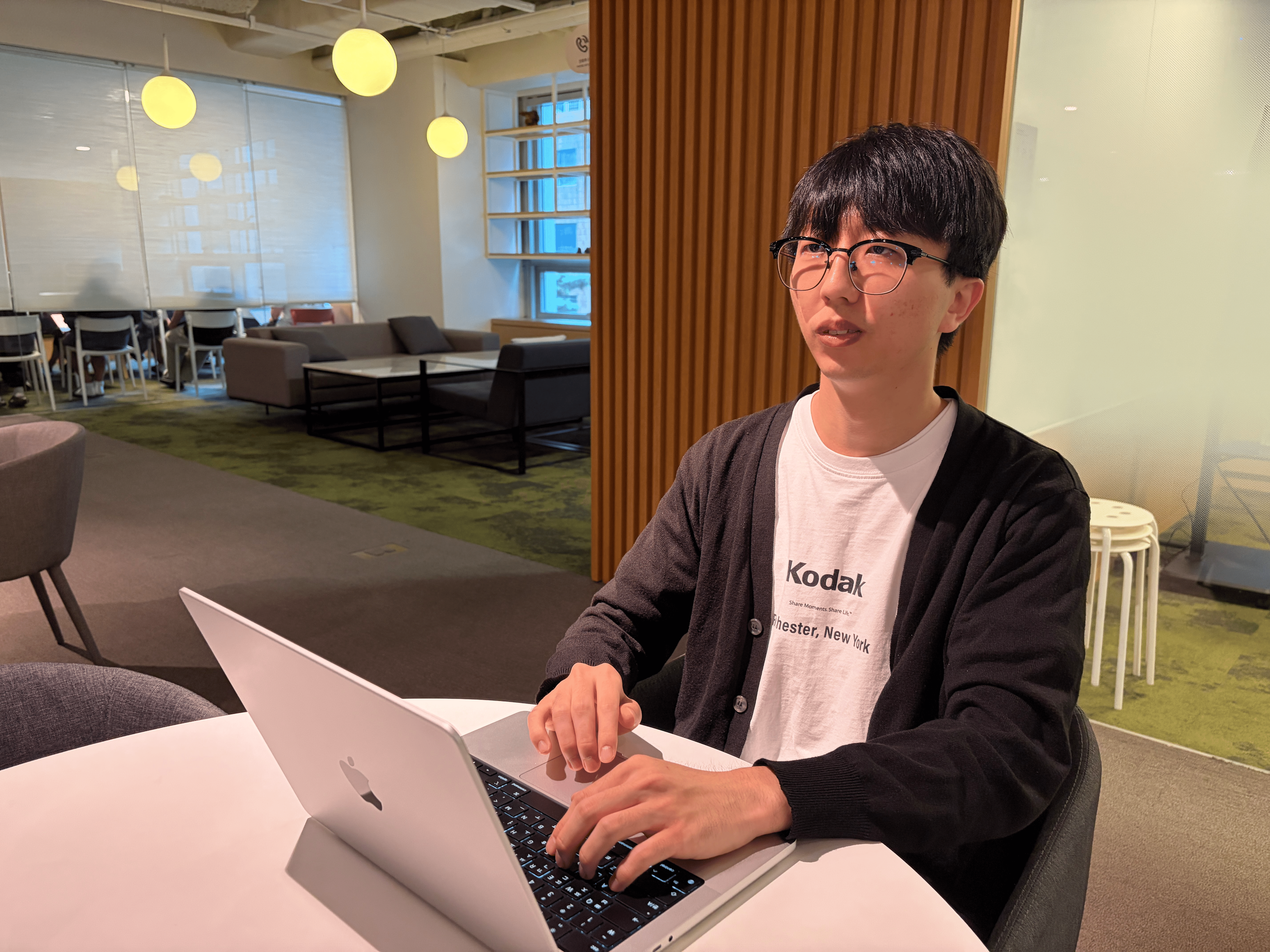
Rob, backend engineer at MODI Factory

