
Teams
・
.
.
Find the start, not the answer
A conversation with Hazel, Strategic planning, Lead — MODI Factory
In an era where AI even writes draft proposals for us, what is a planner's true weapon? Hazel, who has built products in highly specialized and challenging tech domains from autonomous driving to AI financial investments, finds the answer in "the attitude of finding a starting point amid imperfection."
Behind MODI Factory's 'Placement note' and 'Altium extension integration' updates—which recently drew enthusiastic responses from global engineers at electronica India 2026 in Bengaluru—lies the deep contemplation of the Strategic planning team. They focused relentlessly on the actual pain points of users rather than flashy technology. Join us as we explore the vivid planning journey of Hazel, who treats developers as her most important internal customers and constantly asks, "What should we build?"
Read Hazel's interview if you are:
✅ A planner struggling in highly specialized tech domains
✅ A practitioner wrestling with the UX/UI of AI products
✅ Someone who needs to build synergy with development teams
Part 1. How planning and development breathe together amid technological innovation
Could you introduce yourself and tell us about the roles and responsibilities of the Strategic planning team you are leading at MODI Factory?

Hazel, Strategic planning team Leader, MODI Factory
Hi, I'm Hazel. Before joining, I worked in autonomous driving service planning and as a PO for an AI financial investment product. Currently, I am responsible for connecting the product with users on the MODI Factory Strategic planning team. Since I haven't been at LUXROBO for long, rather than leading the team, I am focusing on product planning while collaborating with various teams.
You've experienced numerous shifts in products and markets so far. What made you take on such a highly specialized domain with a steep barrier to entry?
Because I stayed at my first company for a long time, I think I kept choosing roles where I could build products using new technologies after that. Both autonomous driving and AI financial investments were unfamiliar fields to me at first. In line with the robotics and AI trends, I wanted to experience another specialized domain: designing PCBs with AI.
I'm curious about the number one planning principle you have consistently held onto, even as technology trends change rapidly.
I think we need to constantly re-evaluate our standards to keep pace with changes. Now that AI allows us to build features quickly and easily implement good UX, asking "what we should build" has become more important than "what we can build." Continually verifying whether there is actual user demand and whether the product can survive commercially is a crucial standard in product planning.
For a technically demanding product like MODI Factory, tight synergy with the development team seems essential. Could you share any know-how on communicating and coordinating to set the product's direction?
I try to communicate by treating developers as internal customers. I try to understand any discomforts or requirements they might have when collaborating with the planning team, and I do my best to reflect those needs during our project collaborations. The more difficult the domain, the more I rely on the knowledge and know-how of colleagues with extensive field experience. (Laughs)
Part 2. Planning an AI that explains the process, not just the result
We recently announced major updates like the 'Placement note' and 'Altium extension integration'. What was the core user value the Strategic planning team aimed for when planning these updates?

MODI Factory placement note (left) and Altium Extension (right), added in the recent update
These two features approach the user's workflow from different angles. The Placement note helps users understand and review the results generated by the AI, while the Altium extension allows them to use MODI Factory's automated placement and routing without drastically changing their existing design environment. I believe the transition of the user's workflow over to AI needs to be comprehensible and natural.
The EDA market is a field with a very high barrier to switching tools. What do you consider most carefully in UI planning and user journeys so that engineers can naturally use MODI Factory without breaking their familiar workflows?
I think the focal points in UX differ depending on the product's stage. Right now, rather than prioritizing detailed interaction optimization, our first priority should be identifying when, why, and how repeatedly users utilize MODI Factory. By providing for those needs and letting user journeys accumulate, I believe we can refine the UX based on actual usage flows.
The Placement note is a unique feature that doesn't just hand over a result, but provides feedback and guidance on components. Where did the awareness come from that drove the direction of an "AI that explains its design reasoning" instead of just tossing out an output?
For PCB design, which requires complexity and precision, it doesn't seem to be enough for the AI to just generate a result. To apply it to real-world designs, it is vital for engineers to understand and evaluate the output. That's why we provide the placement status and points to review alongside the final result. As MODI Factory continues to evolve, I hope it becomes a product that grows together with engineers while genuinely aiding their design processes.
You recently took these deliverables to Electronica india 2026 in Bengaluru. What were the actual reactions of global engineers who tried out the Altium integration and Placement note firsthand at the local booth?
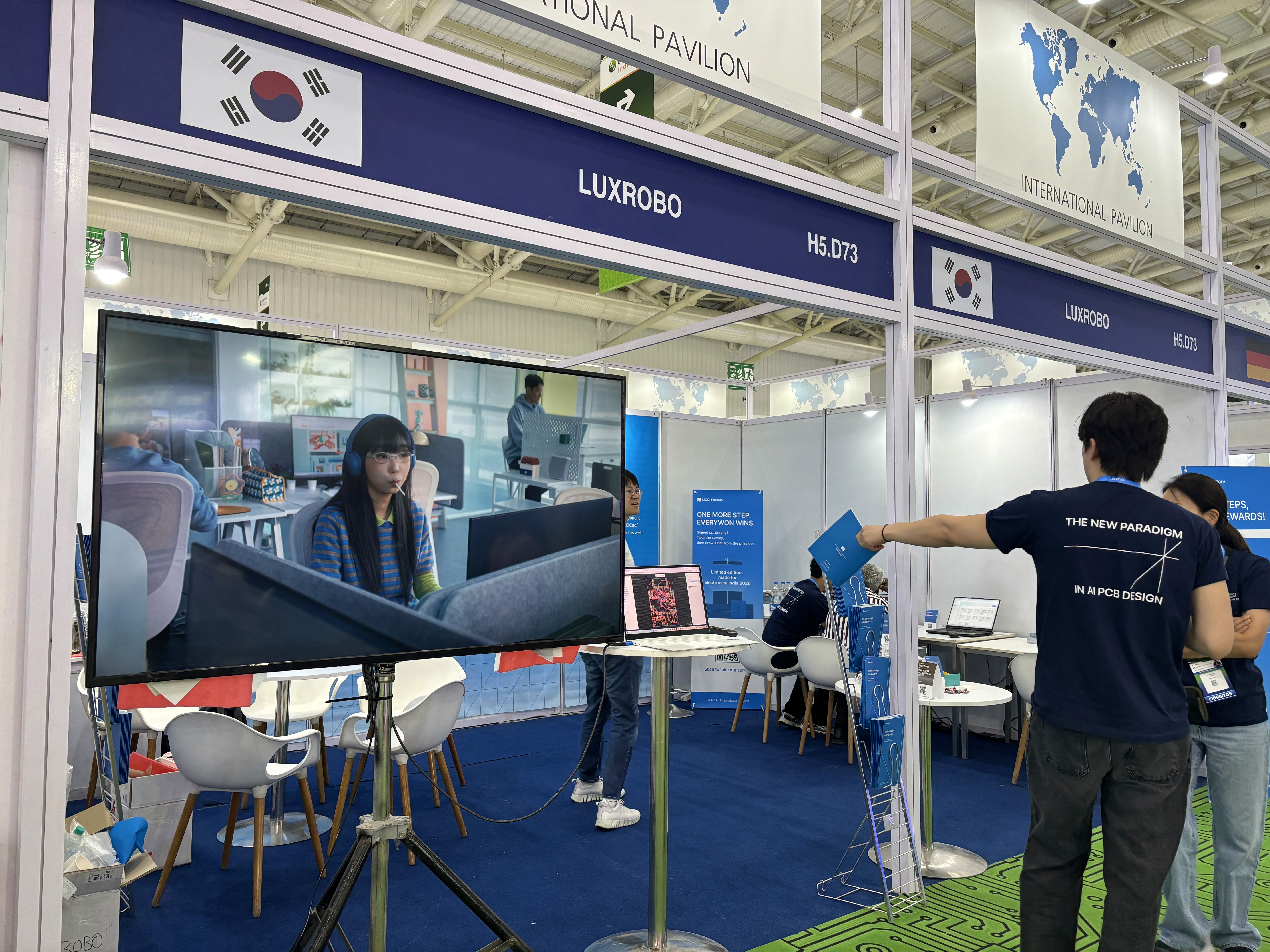
LUXROBO MODI Factory team booth at electronica India 2026
Many people showed interest in MODI Factory's auto-routing and placement, and watched our product demos. It was also great to see demand for upcoming features like DRS and DRC. The interest at the exhibition was certainly welcome, but I'm eager to track the ongoing responses of our newly registered users to see how they continuously integrate MODI Factory into their work.
Going beyond the domestic market, what were some new realizations you had while directly interacting with the local hardware ecosystem and global professionals in India? And what clear competitive edge did you verify for MODI Factory in the global market?
I think what users want isn't just "AI automation" in the abstract, but specifically how much it can cut down their actual working hours and how naturally it fits into their existing design processes. I confirmed that there is genuine interest in PCB design automation in the global market, and I believe we are at the stage of building MODI Factory's unique competitive edge by turning that interest into practical usage.
Part 3. The roadmap, and a few things worth passing on
In our previous interviews with Joe and Rob, a roadmap that moves beyond extensions for existing EDA tools toward a standalone editor of its own was mentioned. From the perspective of overseeing product planning and strategy, what is the ultimate "completed product" that MODI Factory aims to achieve?
At this stage, I think it is becoming a product that users return to and use repeatedly.
When the Strategic planning team plans products (screens, services, etc.), what is the standard of planning that you emphasize the most to your team members?
I received a similar question during my job interview. Since my team members all possess their own expertise and field experience, I view our relationship as one where we learn from and influence each other. During planning discussions with fellow planners, I find we come to understand what each of us values and what criteria we use to make decisions.
Personally, the standards I value most are three things: Does this plan align with our business direction? Does it provide valuable help to the user? And are we working in a way that allows the planners themselves to grow? I hope my colleagues will keep me in check to ensure I am working by those standards.
We are now in an era where AI can even draft planning documents and wireframes. From the perspective of a veteran planner, where do you think the core, irreplaceable competitive edge of a planner lies?
I also wonder about the planner's role in the AI era these days. Planners begin their work in a much more incomplete state than you might think. Even without sufficient evidence, we set up hypotheses, create a draft within the deadline, and then refine our direction by incorporating new information and opinions from various people. Rather than producing a perfected answer, I believe a planner's competitive edge lies in the ability to find a starting point amid incomplete information.
Of course, if an AI agent eventually comes to understand more data, the company's context, and the nuances that arise during collaboration, the story might change. When that time comes, I'll have to figure out a new way to survive. (Laughs)
Lastly, is there anything you'd like to say to junior planners who are wrestling with complex tech domains?

Hazel, Strategic planning team Leader, MODI Factory

